
Your Wi-Fi drops halfway through a task, and the AI assistant you rely on stops working. That frustration is one reason chipmakers and phone makers are moving AI onto the device in your hand. In 2026, on-device AI is no longer a lab demo. It powers live translation on phones, local transcription on laptops and, at the high end, mini PCs that run very large models. This guide explains what it is, how it works, where it beats the cloud and where it still falls short.
What Is On-Device AI?
On-device AI is artificial intelligence that runs directly on your phone, laptop or tablet instead of on a remote server. Your device's own chip does the processing, so many tasks work offline, respond quickly and keep your data on the device. You will also see it called local AI or offline AI.
Cloud AI, such as most popular chatbots, sends your request to a data center and returns the answer. On-device AI skips that trip. Think of it as the difference between phoning a research library and keeping a smaller, well-chosen shelf of books at home. You get quick, private answers on whatever the shelf covers, but not everything.
How On-Device AI Works
Three pieces make it possible.
A compact model. Local AI uses a model small enough to store and run on your device. Developers shrink models with techniques such as quantization, which stores a model's numbers at lower precision. Apple's 2025 research described an on-device language model with roughly 3 billion parameters, the learned values that determine what a model can do. Apple documents a newer model in 2026 without giving its parameter count on the developer pages checked for this guide.
An NPU. A neural processing unit (NPU) is a part of the chip built for AI calculations, handling them with less power than a CPU or graphics chip. Phones and AI PCs still lean on the CPU and GPU for heavier jobs.
Enough memory. A model has to fit in RAM. That is why Microsoft's Copilot+ PC standard asks for 16GB of RAM as well as a fast NPU, and why AMD's biggest chips use unified memory, where the processor, graphics and NPU share one pool.
Chipmakers rate NPUs in TOPS, or trillions of operations per second. Microsoft requires 40+ TOPS for Copilot+ PCs, and Qualcomm says its Snapdragon X2 Elite chips reach 80 TOPS. Treat TOPS as a rough guide, not a verdict. AMD's own footnote says its figure is a maximum in optimal conditions and may not be typical.
On-Device AI vs Cloud AI
Neither is better in every situation. Here is how they compare.
| On-device AI | Cloud AI | |
|---|---|---|
| Where it runs | Chip in your phone or laptop | Remote data center |
| Privacy | Data can stay on your device when a feature runs locally | Requests travel to company servers; policies vary |
| Offline use | Works without internet | Needs a connection |
| Speed | No network delay; fast for short tasks | Network delay, but powerful hardware for big jobs |
| Capability | Smaller models; good at focused tasks | Largest models; best for complex reasoning |
| Cost to use | Often no per-use fee, but you pay for capable hardware | Free tiers, then subscriptions or usage limits |
| Battery and heat | Uses your battery; heavy use warms the device | Little load on your device |
Most products now mix both: a small local model for quick, private tasks and a cloud model for heavy reasoning. For a look at the big cloud assistants, see our ChatGPT, Claude and Gemini comparison. To see how cloud AI is reshaping search, read how AI search is changing the internet.
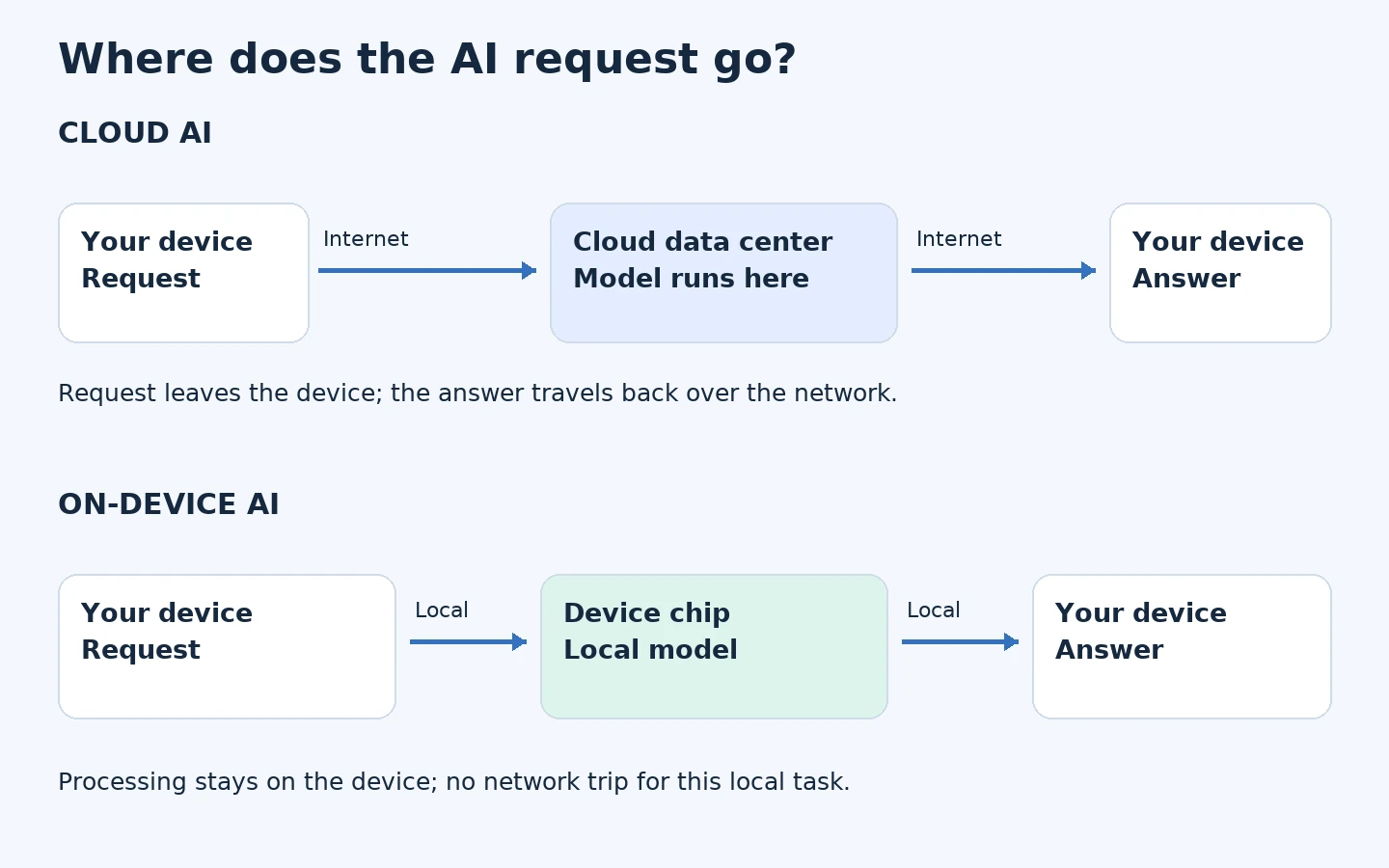
Benefits: Privacy, Offline Use, Speed and Cost
Privacy. When a feature genuinely runs locally, your text, audio or photos do not need to leave the device. That matters for meeting notes, documents and personal messages. It is also why privacy-focused hardware is gaining attention; see why privacy-first, offline-mode gadgets are selling.
Offline use. On a flight, in a basement or during an outage, local features keep working.
Speed. With no network round trip, short tasks such as translating a sentence or tidying a photo can feel instant.
Cost. Local features usually carry no per-use fee, and Apple says its Foundation Models framework gives developers free on-device inference. But the saving is partly upfront. You pay for capable hardware, from the Pixel 11's $899 U.S. list price to thousands of dollars for AMD's developer mini PCs.
Limits: Model Size, Battery, Heat and the Quality Gap
On-device AI has real constraints, and marketing rarely mentions them.
- Smaller models. Phone-sized models are far smaller than the biggest cloud models. They handle summaries, rewrites and translation well, but struggle with long, complex reasoning. Apple sends harder requests to its Private Cloud Compute servers for this reason.
- Battery and heat. NPUs are efficient, but sustained work on the CPU or GPU drains batteries and warms the device. Large local models suit plugged-in machines best.
- Memory and price. Bigger models need more RAM, which raises the price of the device.
- Speed at the top end. Large local models can be limited by memory bandwidth, not only by NPU speed. Fitting a model into RAM does not guarantee quick answers; performance depends on the model, quantization and hardware.
- Newer hardware only. Many features need recent chips, so older devices miss out.
Real Examples of On-Device AI in 2026
Google Pixel and Android phones
Google's Pixel 11 range, announced in August 2026, runs on the Tensor G6 chip. Google says it runs on-device AI models up to 3.5 times faster than the previous generation while using less energy, powering features such as live translation with Gemini Nano. Prices start at $899. Our roundup of Google I/O 2026's AI announcements covers the software side, and why AI phones are the future explains the wider shift.
Apple iPhone, iPad and Mac
Apple's 2025 on-device model had roughly 3 billion parameters. The Foundation Models framework lets third-party apps use local models offline; Apple's 2026 developer documentation describes an updated model but does not state its parameter count. At WWDC 2026, Apple added image input and let apps route heavier work to Private Cloud Compute.
Windows Copilot+ PCs
Microsoft's Copilot+ label requires an NPU of 40+ TOPS, 16GB of RAM and 256GB of storage. Intel, AMD and Qualcomm chips can qualify. Features such as real-time translation and image generation lean on that NPU.
AMD Ryzen AI Max: the high end
AMD is the high-end example, and it is where our original story needed correcting. Here is what AMD's own pages support.
- Big models locally. AMD says its Ryzen AI Halo developer platform, built on the Ryzen AI Max+ 395 with up to 128GB of unified memory, can run models of up to 200 billion parameters locally. That is AMD's figure. Models that large typically need heavy compression to fit, and speed depends on memory bandwidth.
- "Agent Computers." AMD uses this term for PCs meant to run AI agents continuously in the background. It is a marketing category, not a standard.
- A real demo. At CES 2026, AMD and Liquid AI showed a 2.6-billion-parameter model that summarizes a 60-minute meeting in about 16 seconds in Liquid's benchmark, using under 3GB of RAM. It is a narrow, purpose-built model, not a general chatbot.
- Availability. The Halo was listed at Micro Center for $3,999 in July 2026 with in-store pickup, aimed at developers rather than everyday buyers, and early reports described patchy stock. AMD said its Ryzen AI Max PRO 400 chips, with up to 192GB of unified memory, would reach HP and Lenovo systems in the third quarter of 2026. AMD announced a newer Halo on October 12, 2026 with a Ryzen AI Max+ PRO 495 and 192GB of unified memory. Micro Center lists that Linux configuration at $7,299.99, for in-store pickup only; stock varies by store. AMD attributes support for 300-billion-parameter and larger models to 4-bit quantization and up to 160GB of graphics memory. Check current stock in your region.
How to Tell If Your Device Has On-Device AI
- Windows PC: Press Ctrl+Shift+Esc, open the Performance tab and look for an NPU entry. You can also open Device Manager and look for "Neural processors." No entry may mean older hardware or missing drivers. A "Copilot+ PC" label means the 40+ TOPS NPU requirement is met.
- Phone: Check the maker's spec page for the chip (Tensor G6 for the Pixel 11) and its list of on-device features, which can vary by model and region.
- iPhone, iPad or Mac: Check Apple's Apple Intelligence supported-devices list for your model.
- Always check RAM too. A fast NPU with little memory limits which models can run.
Is On-Device AI Really Private?
Mostly, but not automatically. Many products are hybrid. Apple says harder tasks can go to Private Cloud Compute, and its framework can now route work to other providers' cloud models. A feature labeled "AI" may run locally, in the cloud or both, and apps can still sync, log or upload what you create. Check each feature's privacy settings and how it handles data. For wider habits, see our guide to protecting your digital privacy.
FAQ
What is on-device AI?
On-device AI is AI that runs on your own phone, laptop or tablet rather than on a company's server. A chip in the device, often an NPU, does the work, so many features run offline and keep data local.
How is on-device AI different from cloud AI?
Cloud AI sends your request to a remote data center, which can run very large models but needs a connection. On-device AI processes the request locally. It is faster for short tasks and works offline, but uses smaller models.
Is on-device AI more private?
Often, because a locally run feature does not need to upload your data. But many products are hybrid, and apps can still sync or log information, so check each feature's settings rather than assuming.
Does on-device AI work offline?
Yes, for features that run entirely on the device, such as local transcription or translation. Features that call a cloud model, search the web or use live data still need a connection.
What is an NPU and what are TOPS?
An NPU is a processor block built for AI calculations that uses less power than a CPU or GPU. TOPS means trillions of operations per second, a peak-speed rating. Copilot+ PCs need an NPU rated at 40+ TOPS.
Which devices have on-device AI?
Recent flagship phones such as Google's Pixel 11 series, Apple devices that support Apple Intelligence, Windows Copilot+ PCs and AMD Ryzen AI systems all run some AI locally. Check your model's spec page for supported features.
What can't on-device AI do yet?
It cannot match the largest cloud models on complex reasoning or very long documents, and big local models strain memory, battery and heat. Heavy tasks usually still fall back to the cloud.
Conclusion
On-device AI is not a replacement for the cloud. It is a second option that wins when privacy, offline access and instant response matter, and loses when you need the most capable model. The practical move in 2026 is to learn which of your features run locally, weigh the hardware cost against the limits, and expect most tools to blend both. AMD's high-end machines show how far local AI can stretch, and your phone and laptop show how much of it you may already be using.